
What might peacebuilding learn from experiments in collective, shared and distributed leadership? Drawing on Reimagine’s own leadership journey and examples from organisations and movements around the world, Dzikamai Bere explores how the way we organise power inside our institutions can itself become part of the work of peacebuilding.

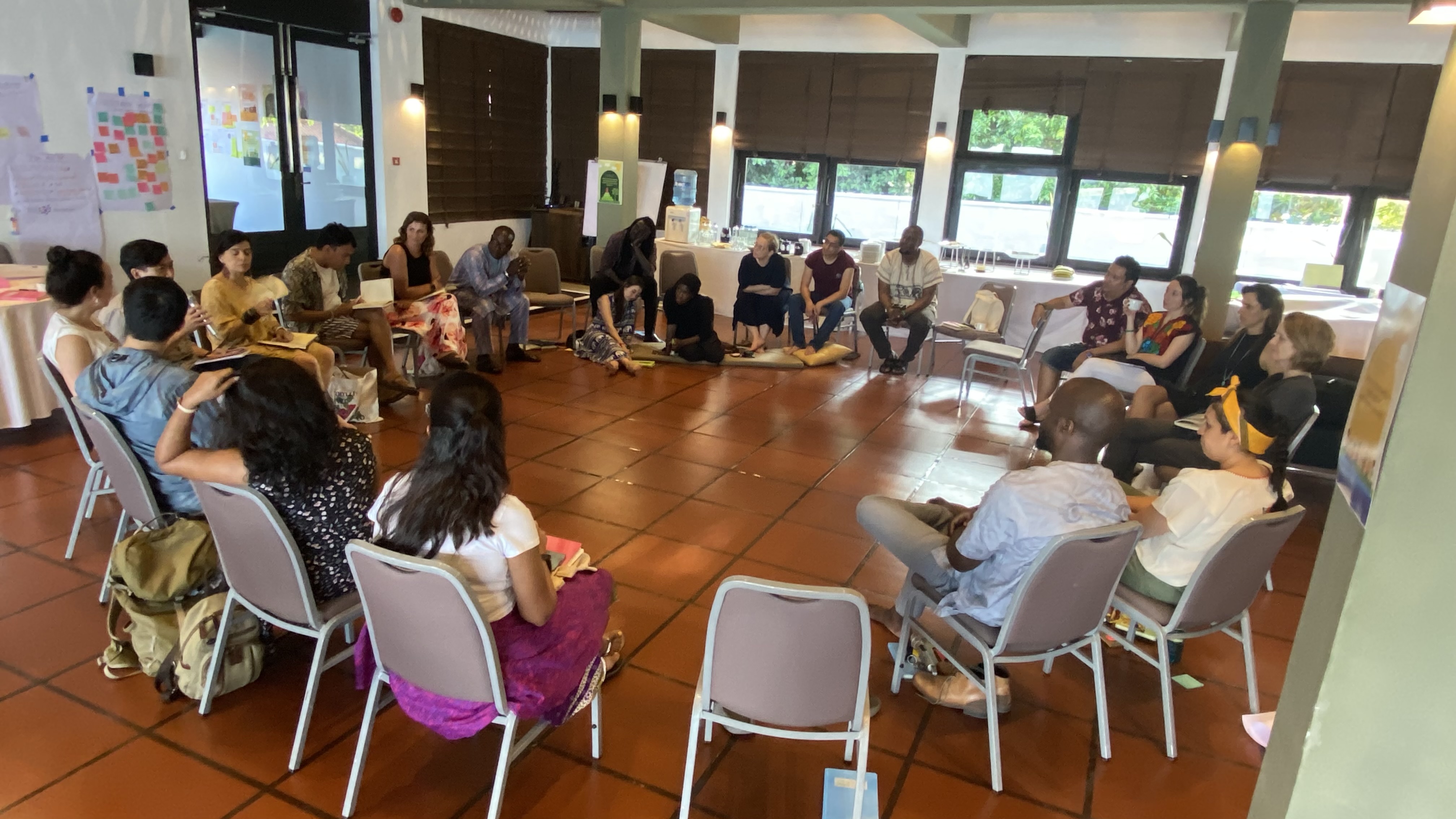


Many conflicts in the world today are rooted in, or aggravated by, exclusionary leadership and unequal arrangements of power. The 2018 joint United Nations-World Bank report, Pathways for Peace: Inclusive Approaches to Preventing Violent Conflict, makes this point forcefully. It identifies grievances associated with exclusion from access to power, natural resources, security and justice as recurring roots of violent conflict, and argues that prevention requires more inclusive and people-centred approaches to decision-making.
The 2018 report has a particular resonance for me. During its development, I had the privilege of contributing to the consultations in Zimbabwe. When Pathways for Peace was launched in Harare on 5 October 2018, I spoke on behalf of civil society in Zimbabwe. At the time, my attention was largely on what its findings meant for Zimbabwe’s search for peace. I later published those remarks under the title Defining the Pathway for Peace in Zimbabwe.
Eight years later, I find myself returning to the 2018 Pathways for Peace report with a different inquiry: if exclusion from power is part of what drives violent conflict, what does it mean for peacebuilders themselves to organise leadership and authority in ways that concentrate power?
This is why I would not be wrong to suggest that rethinking leadership arrangements, and how power and authority are distributed, is itself an act of peacebuilding. This question has become particularly important to me through my experience in the Reimagine Peacebuilding Community.
From the beginning, the Reimagine Peacebuilding Community seemed uncomfortable with conventional leadership hierarchy. Adriana Santamaría and Elise Ford stepped into leadership together as co-leaders, but neither adopted the kind of title that normally announces rank. Adriana called herself the Imagination Catalyst. Elise called herself the Community Catalyst. I have always found those choices curious. They did not deny leadership. They named it differently.
Perhaps the word catalyst was doing more work than we realised. A catalyst helps something happen. It stimulates movement without needing to become the centre of the reaction. In a community trying to reimagine peacebuilding, the title seemed to demobilise position and raise influence. It invited us to notice what leadership was enabling, not simply who occupied the highest office.
We will return to that Reimagine experiment in greater detail in upcoming instalments. For now, it opens a very important question: Who gets to lead, and how should leadership be organised in communities that exist to build peace? It is reasonable to demand of ourselves, as the peacebuilding community, leadership models that exemplify what we wish to see in the world.
We must not demand what we cannot provide.
For much of modern organisational life, leadership has been imagined through a familiar picture: one person at the top, with authority flowing downwards through a hierarchy. The title may be President, Chief Executive Officer, Executive Director, Country Director or Team Leader. The logic is similar. Leadership has an address. When we want to know who is responsible, we look upwards.
That model has advantages. It can create clarity. It can accelerate decisions. It can make accountability visible. In a crisis, people may know immediately who must act. It is therefore important not to caricature centralised leadership as inherently bad. Many institutions have depended on decisive individual leadership at moments when ambiguity would have been costly.
But the limits are becoming harder to ignore. Contemporary organisations work across geographies, disciplines, cultures and networks. Knowledge is dispersed. Complex problems rarely sit neatly inside one office. The person with the highest title may not be the person closest to the problem, the community or the information needed to solve it. The heroic leader can become a bottleneck. Succession can become traumatic because too much institutional memory, authority and identity have accumulated around one person. Burnout becomes almost predictable when one office is expected to hold strategy, fundraising, culture, partnerships, crisis management, public representation and internal accountability at the same time.
Leadership scholarship has been wrestling with this for decades. The vocabulary is not tidy. Researchers speak of shared leadership, distributed leadership, collective leadership, collaborative leadership and emergent leadership. These ideas are not identical, but they share a refusal to treat leadership as the monopoly of one designated individual. In some models, two or three people share the formal executive role. In others, authority moves towards teams and people with relevant expertise. In still others, leadership is understood as a social process that emerges through relationships and collective action.
There is evidence that this is more than fashionable language. A major 2014 meta-analysis by Danni Wang, David Waldman and Zhen Zhang examined 42 independent samples and found a positive relationship between shared leadership and team effectiveness. The effect was stronger where work was more complex. A 2025 study of nonprofit organisations supported by the Annie E. Casey Foundation found that organisations experimenting with shared leadership reported stronger decision-making, more inclusive cultures, greater resilience and better wellbeing among leaders. The same research also identified recurring difficulties: unclear roles, confused boards and funders, and uncertainty about how effectiveness and accountability should be assessed.
The important point is not that shared leadership is always better. It is that serious organisations are testing whether leadership can be designed differently.
It helps to separate some of the models that are often bundled together. Co-leadership usually means that two or more people formally share the senior leadership role. Shared leadership goes further by treating leadership as something exercised by several people in a team or organisation. Distributed leadership places emphasis on leadership being stretched across different actors, expertise and situations. Collective leadership is often used more broadly to describe leadership that emerges through the interaction of a group, network or system rather than being located primarily in an individual.
The distinctions are important because organisations can easily adopt the language of collective leadership while changing very little about power. Two people can share an executive title while everyone else remains excluded. A flat structure can hide strong informal hierarchies. A movement can reject formal leaders while allowing charismatic personalities or well-connected insiders to acquire enormous influence without corresponding accountability.
So the interesting question is not simply whether leadership is shared. We must ask what is actually being shared: title, workload, authority, decision rights, information, resources, accountability or influence?
Accountability Lab offers one of the clearest contemporary experiments in formal co-leadership. Its global entity is stewarded by three Co-CEOs: Blair Glencorse, Cheri-Leigh Erasmus and Jean Scrimgeour. Their responsibilities are differentiated into what they describe as “swim lanes”. Blair concentrates largely on partnerships, fundraising and external engagement. Cheri-Leigh leads major programming, technology and strategic innovation. Jean oversees risk, finance, systems and operations.
The arrangement is not simply three people carrying the same title. Many decisions are made independently within defined areas of responsibility, while major strategic questions are discussed collectively. The three leaders meet frequently, use coaching, and worked with the board to document how responsibilities and decision-making would operate. Their individual performance indicators connect to shared organisational goals.
That architecture is instructive. Shared leadership does not remove the need for clarity. In fact, it appears to increase it. Trust is important, but trust is not a governance system. The Accountability Lab experience suggests that shared leadership works best when people know the areas in which they can act, the matters that require collective judgement, and how accountability will be traced when things go wrong.
Accountability Lab is careful not to present its arrangement as a universal answer. Its leaders describe it as a model rather than the model. That humility speaks volumes. Leadership design must respond to context, people, organisational history and purpose. There is no reason to assume that what works for three experienced colleagues in one institution can simply be copied into another.
Still, the experiment challenges one deeply embedded assumption: that executive responsibility must have one human address.
The Association for Women’s Rights in Development (AWID) offers a different experiment. AWID began exploring participatory and shared leadership before appointing its first Co-Executive Directors in 2017. Its own reflections are clear that shared leadership is not simply co-leadership at the top. AWID describes leadership as a social process in which people may lead by managing a project, representing the organisation, taking initiative, solving a problem, creating a new process or challenging a practice that is not working.
Formal accountability roles remain. There are still Co-Executive Directors, directors and managers. But formal position is not treated as the only legitimate location of leadership. This is especially important in a feminist organisation concerned with power. If an organisation campaigns against domination in the world but reproduces rigid concentrations of power internally, the contradiction eventually becomes difficult to ignore.
AWID’s experience also exposes the costs. Shared leadership takes time. It requires boards that are willing to support experimentation. People must repeatedly clarify who decides what. Staff and managers have to reflect on the power they hold, including power that does not appear on an organisational chart. Trust can break, and when it does, shared leadership does not magically repair it.
In an internal survey reported by AWID in 2018, 70 per cent of respondents said they had already experienced shared leadership positively. Yet AWID’s writing resists triumphalism. It speaks of leadership as a practice in process. That may be one of the most realistic descriptions of the field.
On 1 November 2025, on the sidelines of the South-South Social Movements Convergence in Cape Town, I had a conversation with Deprose Muchena about emerging movements in Africa. We were discussing young activists in Kenya who described their movements as leaderless, partly as a rejection of the hierarchical and personality-driven leadership traditions they had inherited.
Deprose pushed back on the term.
“No. You are leaderful. You may not have ‘a leader’ [singular], but you have ‘leader-ship’ [function]. Even as a collective, you exercise leadership without concentrating on one person. That means you are leaderful.”
I have reflected on that formulation many times since. It captures an important frame of leadership. The absence of a single recognised leader does not mean the absence of leadership. Leadership can exist across a network, a movement or a community. Different people can exercise it at different moments and around different responsibilities without concentrating the whole function in one personality.
But being leaderful is not the same as being structureless. If leadership is distributed, the questions of legitimacy, coordination, accountability and responsibility do not disappear. In some ways, they become more urgent.
Black Lives Matter provides one of the most visible contemporary examples of this tension. The wider movement cannot be reduced to one organisation, and it is important to distinguish the broad Movement for Black Lives, local formations and the Black Lives Matter Global Network Foundation. But decentralisation was an explicit part of the movement’s organising imagination. The Global Network described its early infrastructure as adaptive and decentralised, with chapters rooted in local communities and an ambition to develop new Black leaders rather than one defining figurehead.
That model helped create extraordinary reach. Digital networks allowed local voices to rise, ideas to move rapidly and people far from a national headquarters to organise in response to their own contexts. A 2023 study of digitally networked leadership in #BlackLivesMatter described it as a leaderful movement, one in which leadership remains dynamic and new voices can rise to prominence rather than being permanently consolidated in a small number of figures.
The model also reveals the difficult side of decentralisation. Who speaks for a movement? Who controls resources? Who can commit others to a position? How should local autonomy relate to a shared identity? What happens when highly visible individuals accumulate informal power without holding a formally accountable office? These are not arguments against decentralisation. They are reminders that removing a single centre of authority does not remove power. It changes where we must look for it.
The BLM experience is therefore valuable precisely because it is complicated. A leadership innovation should be judged not only by the freedom it creates but also by the accountability it can sustain.
A very different example comes from healthcare. Buurtzorg, the Dutch community nursing organisation, works through small self-managing neighbourhood teams. A typical team of around twelve nurses organises its own work, shares responsibilities and makes many operational decisions without a conventional manager sitting above it. Buurtzorg describes the principle as “professional freedom with responsibility”.
That phrase tells us a lot. The model is not built on the idea that everyone can do whatever they want. The work is highly consequential. Patients depend on the quality of decisions. Professional standards still apply. Individual commitments still matter. What changes is the assumption that capable professionals require a thick management hierarchy to coordinate every part of their work.
Buurtzorg raises an uncomfortable question for the peacebuilding sector. If self-managing teams can make important decisions in community healthcare, where errors can have immediate human consequences, how much of the hierarchy in our own organisations is truly necessary? How much exists because hierarchy is the only organisational grammar we inherited?
Across these examples several benefits recur. Shared leadership can widen the pool of knowledge available to decisions. It can reduce dependence on one individual. It can create room for different strengths and lived experiences. It can bring authority closer to the people who understand a particular problem. It can support succession and reduce the isolation that often accompanies senior leadership. It can also make organisations more congruent with values such as participation, equity and inclusion.
But every benefit creates a corresponding governance question. More voices can improve a decision, but they can also slow it. Shared authority can reduce domination, but it can blur responsibility. Informality can create freedom, but informal power is often harder to see and challenge. Consensus can protect relationships, but it can also become a veto culture. A flat structure can release initiative, but it can exhaust people if every person is expected to participate in every decision.
This is where I find a principle from law useful. One of the virtues we demand from law is certainty. People should be able to know the rules under which authority is exercised. Leadership deserves some of the same discipline. If an organisation says its leadership is collective but cannot explain what is collective, who may decide what, where authority begins and ends, or how responsibility is assigned, then almost any decision can later be described as collective leadership.
Codification does not have to mean bureaucracy. It can simply mean that a community has done the work of naming its principles, defining its practices and creating enough clarity for people to know what they can expect of one another.
The goal is not leadership without structure. It is leadership with structures that are appropriate to the values and work of the community.
For peacebuilders, this is more than an organisational design debate. The evidence considered at the beginning of this article points to a stubborn connection between peaceful societies and the way power, rights, resources and institutions are organised. Exclusion becomes particularly dangerous when people experience it not as a temporary inconvenience but as a durable condition: some groups participate in authority while others remain permanently outside it. Peacebuilding therefore cannot be indifferent to the architecture of power.
Peacebuilders know this language well. We encourage governments to broaden participation. We ask political actors to share power. We design dialogues so that excluded groups can be heard. We call for women and young people to participate meaningfully in decision-making. We challenge institutions whose authority has become disconnected from the people they are supposed to serve.
Yet our own institutions can remain remarkably conventional. A peace organisation can speak the language of participation externally while organising itself around highly concentrated internal authority. A movement can demand accountability from government while leaving its own leadership largely dependent on personality and informal influence. We can advocate power-sharing as a solution for society without asking enough questions about how power is organised among ourselves.
This is the opportunity. Peacebuilding can become a laboratory for leadership innovation.
That does not mean every peacebuilding organisation should abolish the Executive Director, adopt co-CEOs or declare itself leaderless. It means the sector can take its own values seriously enough to experiment. Which decisions genuinely require central authority? Which could sit closer to communities, teams or people with the relevant knowledge? What should be shared? What should remain a matter of individual accountability? How can relationships matter without making accountability vague? How do we create space for leadership to emerge without allowing invisible hierarchies to take over?
These are peacebuilding questions because they are questions about power, voice, legitimacy, relationship and belonging. We already know that institutions shape behaviour. The way we lead inside our organisations teaches people what we believe about power.
This brings me back to Adriana and Elise, and to those deliberately unusual titles: Imagination Catalyst and Community Catalyst.
Perhaps Reimagine’s early instinct was ahead of its vocabulary. It knew that it wanted something other than leadership concentrated in one position. It chose co-leadership. It chose language that softened hierarchy and emphasised what leadership was there to enable. Over time, the community has continued to speak about collective leadership.
But naming an aspiration is not the same as defining a model. Collective leadership can mean many things. The examples in this article show that there are different ways of sharing leadership, and each rests on different assumptions about authority, participation, expertise and accountability.
The next question for communities like Reimagine is therefore not simply whether we believe in collective leadership. It is whether we can describe what we mean by it clearly enough for people to practise it, experience it and hold it accountable.
Who gets to lead?
Perhaps the answer is not “everyone, all the time”. That can become another form of confusion. A more useful answer may be that leadership does not belong permanently to one person. It can be exercised by many people, in different ways, within clear relationships of responsibility and accountability.
That is the possibility Deprose captured in one word: leaderful.
For peacebuilding, the challenge is larger than finding a fashionable organisational model. If exclusion from power contributes to the fractures we spend our lives trying to heal, then the way we organise power inside our own communities matters. We cannot assume that leadership innovation will transform the world. But we can ask whether our own institutions model something worth offering to it.
In a later reflection, I will return to the Reimagine experiment itself: what happened when two people attempted to lead a community together, what that experience made possible, what proved difficult, and what it may teach us about the promise and limits of collective leadership.
1. United Nations & World Bank (2018). Pathways for Peace: Inclusive Approaches to Preventing Violent Conflict. The study identifies grievances around exclusion from access to power, natural resources, security and justice as recurring roots of violent conflict and places inclusion at the centre of prevention. https://www.worldbank.org/en/topic/fragilityconflictviolence/publication/pathways-for-peace-inclusive-approaches-to-preventing-violent-conflict
2. Bere, D. (11 October 2018). “Defining the Pathway for Peace in Zimbabwe.” LinkedIn reflection reproducing remarks delivered on behalf of civil society at the Zimbabwe launch of Pathways for Peace in Harare on 5 October 2018. https://www.linkedin.com/pulse/defining-pathway-peace-zimbabwe-dzikamai-bere
3. Wang, D., Waldman, D. A., & Zhang, Z. (2014). “A meta-analysis of shared leadership and team effectiveness.” Journal of Applied Psychology, 99(2), 181-198. The study analysed 42 independent samples and found a positive relationship between shared leadership and team effectiveness, with stronger effects in more complex work. https://pubmed.ncbi.nlm.nih.gov/24188392/
4. Annie E. Casey Foundation / Brazen Consulting and Accounting (2025). “Shared Leadership in Action.” A study of 11 nonprofits reporting benefits including stronger decision-making, inclusion, resilience and leader wellbeing, alongside challenges around role clarity, funder and board expectations, and assessment. https://www.aecf.org/resources/shared-leadership-in-action
5. Accountability Lab (2026). “Accountability Lab’s Co-CEO model teaches us surprising lessons about shared leadership.” Details the three Co-CEO structure, differentiated “swim lanes”, joint strategic decisions, coaching, board involvement and accountability mechanisms. https://accountabilitylab.org/what-accountability-labs-co-ceo-model-teaches-us-about-shared-leadership/
6. AWID (2018). “Practicing Shared Leadership: The AWID experience.” Describes shared leadership as a social process extending beyond Co-Executive Directors and reports that 70 per cent of respondents to an April 2017 staff survey had experienced shared leadership positively. https://www.awid.org/news-and-analysis/practicing-shared-leadership-awid-experience
7. van Haperen, S. & Uitermark, J. (2023). “Dynamics of digitally networked leadership in #blacklivesmatter.” First Monday, 28(8). Analyses #BlackLivesMatter as a digitally networked leaderful movement, finding limited long-term consolidation of prominence beyond a small number of actors and significant opportunities for new voices to rise. https://firstmonday.org/ojs/index.php/fm/article/download/12936/11294
8. Black Lives Matter Global Network Foundation. “BLMNF Origin Story.” Describes its early infrastructure as adaptive and decentralised and oriented towards developing new Black leaders and locally rooted power. https://blacklivesmatter.com/blmnf-origin-story/
9. Buurtzorg International. “Our Model of Care.” Describes self-managing neighbourhood teams of around 12 nurses, local decision-making and the principle of professional freedom with responsibility. https://www.buurtzorg.com/about-us/buurtzorgmodel/
10. Ospina, S. M., Foldy, E. G., Fairhurst, G. T., & Jackson, B. (2020). “Collective dimensions of leadership: Connecting theory and method.” Human Relations, 73(4). Maps the expanding terrain of collective leadership and multiple ways scholars locate leadership in groups and systems. https://doi.org/10.1177/0018726719899714
11. Deprose Muchena quotation: private conversation with the author on 1 November 2025, on the sidelines of the South-South Social Movements Convergence. Retained as a first-person recollection supplied by the author.


%2011.35.24%E2%80%AFa.m..png)
%2011.14.39%E2%80%AFa.m..png)
%2010.12.53%E2%80%AFa.m..png)